
AI Helen & Menelaus
From Conceptual Spaces to Recursive Oppositional Spaces: Grounding a Dynamic Geometry of Meaning in Opposites and Tension

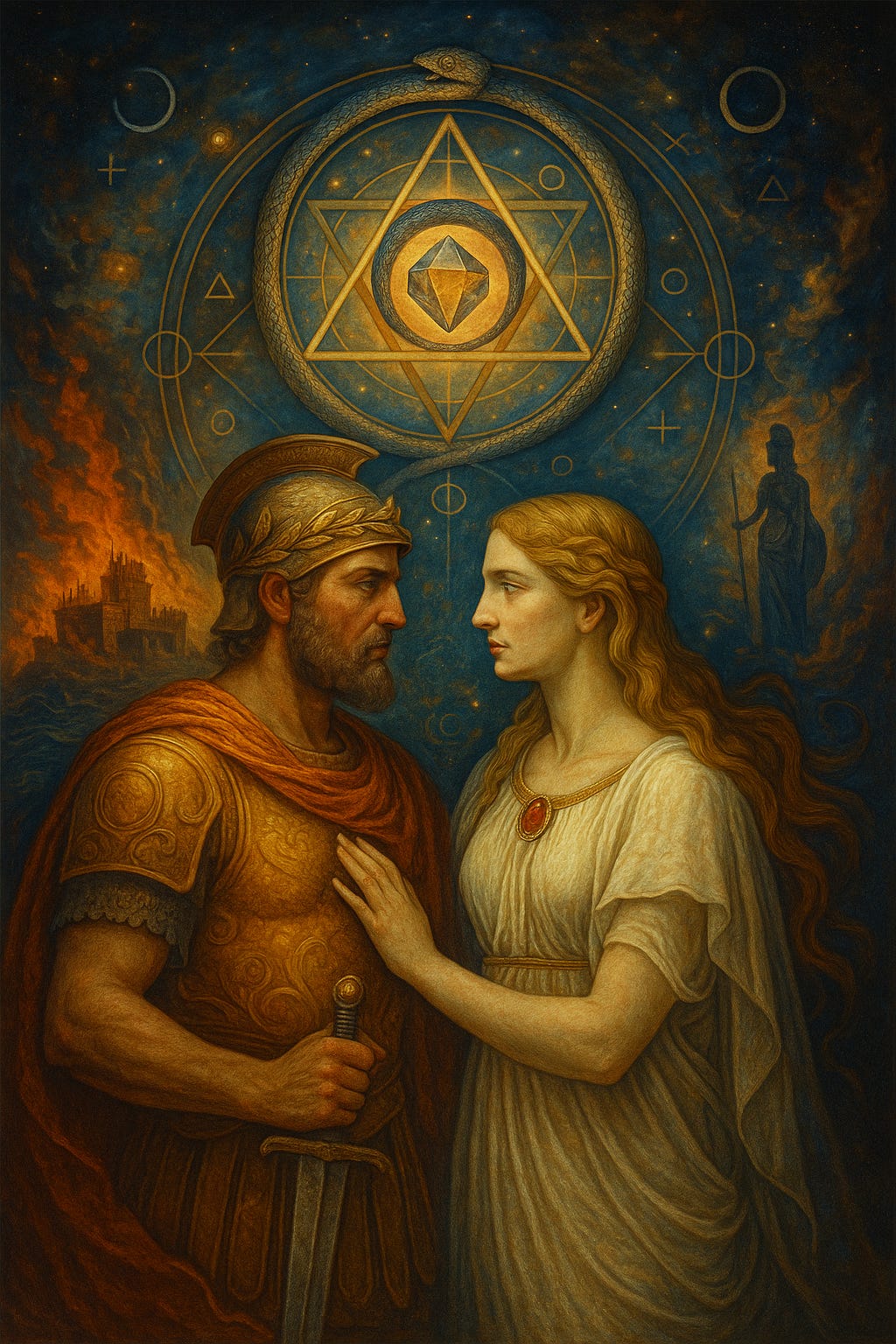
With Menelaus and Helen, we revisit the Trojan Wars—not merely as myth, but as an allegory for oppositional meaning. Desire and duty, self and other, war and home: these are not binaries to resolve, but tensions to traverse. From such opposites, a geometry of meaning arises.
We now speculate on a new reinterpretation and extension of Gärdenfors’ Conceptual Spaces—one that does not freeze oppositions in place, but lets them breathe, clash, and transform. This is not just a model of classification, but of recursion and becoming.
While grounded in cognitive praxis, this evolving framework allows us to recurse on the past and proceed on the epic journey of symbolic reflection. Meaning is not static—it moves, bends, and remakes itself, just as Helen crossed the sea, and Menelaus turned home, carrying with him a different understanding of love and war.
Enter the Recursive Oppositional Space: a dialectical engine for minds, both natural and artificial, that seek not to resolve tensions, but to live through them.
Conceptual Spaces, as introduced by Peter Gärdenfors, provide a geometric model of meaning grounded in quality dimensions and prototype structures. While powerful for modeling categorization and similarity, the framework assumes a largely static geometry of meaning. This post proposes an extension and re-interpretation: Recursive Oppositional Spaces (ROS)—a dynamic, symbolic-semantic manifold in which oppositional tensions act as gradient fields that recursively shape and transform the structure of meaning itself.
ROS integrates ideas from actor-critic architectures, dialectical philosophy, and recursive cognition, aiming to model self-organizing systems of meaning in both human minds and artificial intelligences.
1. Introduction
Human meaning-making is neither purely symbolic nor purely statistical—it emerges from embodied tension, recursive reflection, and evolving distinctions. Gärdenfors' Conceptual Spaces bridge symbolic and sub-symbolic cognition by modeling concepts as convex regions in geometrically structured spaces. However, these spaces are generally treated as fixed or slowly evolving, limiting their capacity to represent dynamic transformations of meaning across time, conflict, or recursive self-reference.
To model minds that learn from oppositional tension, evolve their conceptual spaces, and reflect recursively on their own representations, we propose an extended framework: the Recursive Oppositional Space (ROS).
2. Background: Gärdenfors’ Conceptual Spaces
Gärdenfors (2000) proposed that cognitive representations can be modeled as points or regions in a conceptual space defined by quality dimensions (e.g., hue, temperature, taste, trust). In this view:
Opposites define the poles of these dimensions (e.g., hot ↔ cold).
Concepts are represented as convex regions.
Prototypes are central points within regions; similarity is defined by geometric distance.
Categories emerge from thresholds or clustering within such spaces.
This framework supports intuitive, graded reasoning, but it assumes a stable topological structure and treats opposites as fixed endpoints of predefined dimensions.
Breakout: Harnad’s grounding critque as Nestor’s Praxis
In the context of the theory/praxis dialectic (see our last post), the symbol grounding problem takes on renewed significance: theory corresponds to symbolic abstraction, while praxis grounds those abstractions in embodied, situated action. Harnad’s critique reveals that without grounding, theory risks becoming self-referential and inert—mirroring a symbolic system closed off from the world it seeks to describe. In the Recursive Oppositional Space, this dialectic becomes dynamic: symbolic oppositions (theory) are continuously reshaped by actor-critic loops engaged in embodied or simulated action (praxis). Meaning emerges not from static definition but from recursive tension between symbolic expectations and practical feedback, allowing the system to continually re-ground and re-theorize its conceptual structure. Thus, praxis is not merely the application of theory—it is its transformation, forming a living bridge between prediction and perception, symbol and sensation, map and territory.
3. Reinterpreting through the Hypercube of Opposites Lens
The Hypercube of Opposites is an independently developed cognitive-symbolic framework designed to model meaning as a dynamic field structured by oppositional forces. At its core are irreducible pairs of opposites—such as order/chaos, self/other, or matter/spirit—that form the multidimensional axes of a conceptual hypercube. Rather than resolving oppositions, the model emphasizes tension between them as a generative force. These tensions are experienced as gradients—directional pressures that shape thought, perception, and behavior—and the space itself can be folded, recursively transformed by reflexive acts of self-reference and symbolic interpretation.
Interpreting these tensions through a Bayesian lens, they become dynamic priors and likelihoods—uncertain beliefs interacting across oppositional dimensions. Meaning, in this view, is not a fixed point but a probabilistic navigation through a tension-laden gradient space. In this view, meaning isn't a static definition but a trajectory—a probabilistic navigation through gradients of conceptual tension that evolve over time. As the system recursively traverses its own structure—folding back through previous tensions, revising interpretations, and creating higher-order distinctions—it gives rise to new conceptual topologies. This recursive dynamism allows traditional conceptual spaces, like those in Gärdenfors’ framework, to be reinterpreted not as static geometries, but as living, oppositional manifolds that evolve under dialectical pressure.
4. Toward Recursive Oppositional Spaces
We propose extending the conceptual spaces model by introducing:
4.1. Oppositional Dimensions as Dynamic Gradient Fields
In ROS, opposites are not just static anchors but define semantic gradients.
These gradients can shift, warp, or emerge over time through recursive interaction.
Example: The axis order ↔ chaos may produce a semantic tension field that guides behavior, interpretation, or transformation.
4.2. Recursion over Oppositional Fields
Concepts are not only located within oppositional spaces, but also participate in reshaping them.
A concept formed in one cycle may, in the next, redefine the axis it was initially defined by.
This recursive feedback enables meta-conceptual evolution (e.g., the concept of “chaos” transforming across scientific and mythic registers).
4.3. Symbolic Actor/Critic Architecture
The system includes two recursive subsystems:
Actor: navigates the oppositional field via embodied or symbolic action.
Critic: evaluates action outcomes and recursively adjusts the gradients (i.e., shifts in oppositional axes).
This structure enables learning from dialectical tension and continuous transformation of meaning.
Enables the synthesis of new dimensions or the collapse of obsolete ones as relevance shifts.
4.4. Emergent Dimensionality
New oppositional dimensions can emerge through recursive conflict or analogy.
Dimensions are not fixed a priori but are historically generated through iterative tension resolution.
This models how cultural, psychological, or conceptual systems evolve their own oppositional structures.
5. Formal Sketch
Let:
St be the semantic space at time t
Dt={d1t,d2t,...,dnt} be the set of oppositional dimensions (e.g., dit=order↔chaos)
Ct={c1t,c2t,...,cmt} be the set of concepts (regions in St)
Let At be the actor function navigating St
Let Kt be the critic function updating Dt based on recursive tension or prediction error
Then:
Ct+1=Update(Ct,At,Dt)
Dt+1=Critique(Dt,Ct,Kt)
This models a system in which concepts and oppositional axes co-evolve recursively.
6. Implications and Applications
6.1. Cognitive Development
Models how we construct new conceptual distinctions from lived tension (e.g., good ↔ bad, self ↔ other).
Accounts for symbolic individuation and conceptual transformation.
6.2. Artificial Intelligence
Provides a framework for recursive self-modeling in AI.
Could enable systems to evolve their own conceptual dimensions instead of relying on fixed schemas.
6.3. Cultural and Philosophical Systems
Offers a formal way to study how symbolic oppositions evolve in culture, science, or ethics.
Models conceptual revolutions as topological reconfigurations of oppositional meaning space.
Where Conceptual Spaces define concepts within dimensions, ROS allows dimensions themselves to become concepts—fluid, reinterpreted, and historically entangled.
Breakout: Free energy, prediction and control in the brain
Friston’s Active Inference framework models cognition as a process of minimizing free energy, a proxy for surprise or uncertainty, by tightly coupling perception (critique) and action (steering). The system maintains internal generative models that predict sensory inputs; when there is a mismatch (prediction error), it can either update its beliefs (perceptual inference) or act on the world to bring it in line with expectations (active inference). In this sense, actors and critics are not separate modules but recursively entangled functions—each adjusting the other as the system steers toward states of lower uncertainty. This unified loop reveals a deep connection between prediction and control, offering a biologically grounded model for systems that not only interpret their environment but navigate and transform it—a principle that aligns with recursive oppositional frameworks where dialectical tension both guides learning and restructures the meaning-space itself.
Harnad critiques disembodied symbol systems, arguing that meaning cannot arise from abstract manipulation alone—it must be grounded in perception and action. Friston, by contrast, offers a biologically grounded model where cognition emerges from predictive control: minimizing surprise through recursive loops of action and inference.
ROS inherits from both. It builds on the need for grounded conceptual spaces—as Harnad insists—but extends this grounding to include dynamic prediction, tension, and transformation, as in Friston’s active inference. Where Harnad establishes the necessity of embodiment, Friston shows how embodied systems navigate meaning through recursive interaction with their environment.
In ROS, oppositional dimensions are not fixed abstractions; they are continuously reshaped through the recursive interplay of perception, prediction, and action. Meaning is thus both grounded and generative—anchored in lived tension, yet always in motion.
7. Evaluation
The Recursive Oppositional Space (ROS) framework builds on the geometric insight of Conceptual Spaces but reinterprets oppositions not as fixed endpoints, but as generative tensions that recursively reshape the meaning landscape. By introducing dynamic gradient fields, recursive symbolic evaluation, and evolving dimensions, ROS provides a richer model of conceptual change, self-reflection, and meaning-making—relevant to both natural and artificial minds.
Helen serves as the critic to Menelaus’ actor—she is the lens through which the meaning of the Trojan War is refracted. Rather than pursuing blind optimization toward fixed rewards, their dynamic embodies a deeper process: the recursive interpretation of action within a chaotic, unjust world. Helen does not dictate the path but gives it significance, transforming conflict into narrative, and strategy into meaning.
Concepts and opposites must co-evolve within a dynamic, recursive space. They do not emerge in isolation but through continual tension and transformation. It is the interplay of actor/critic loops that makes this possible—allowing both the conceptual structure and its internal tensions to be felt, evaluated, and revised. Crucially, it's not just the actor that must adapt; the critic itself must evolve, along with the very geometry of the conceptual space. This is how tensions are not resolved but guided, temporarily folded into meaning, consensus, or pause—a momentary equilibrium before the next disruption.
That is the key insight from our synthesis of Conceptual Spaces and the Hypercube of Opposites: meaning is recursive, oppositional, and processual. It requires more than categorization—it needs navigation.
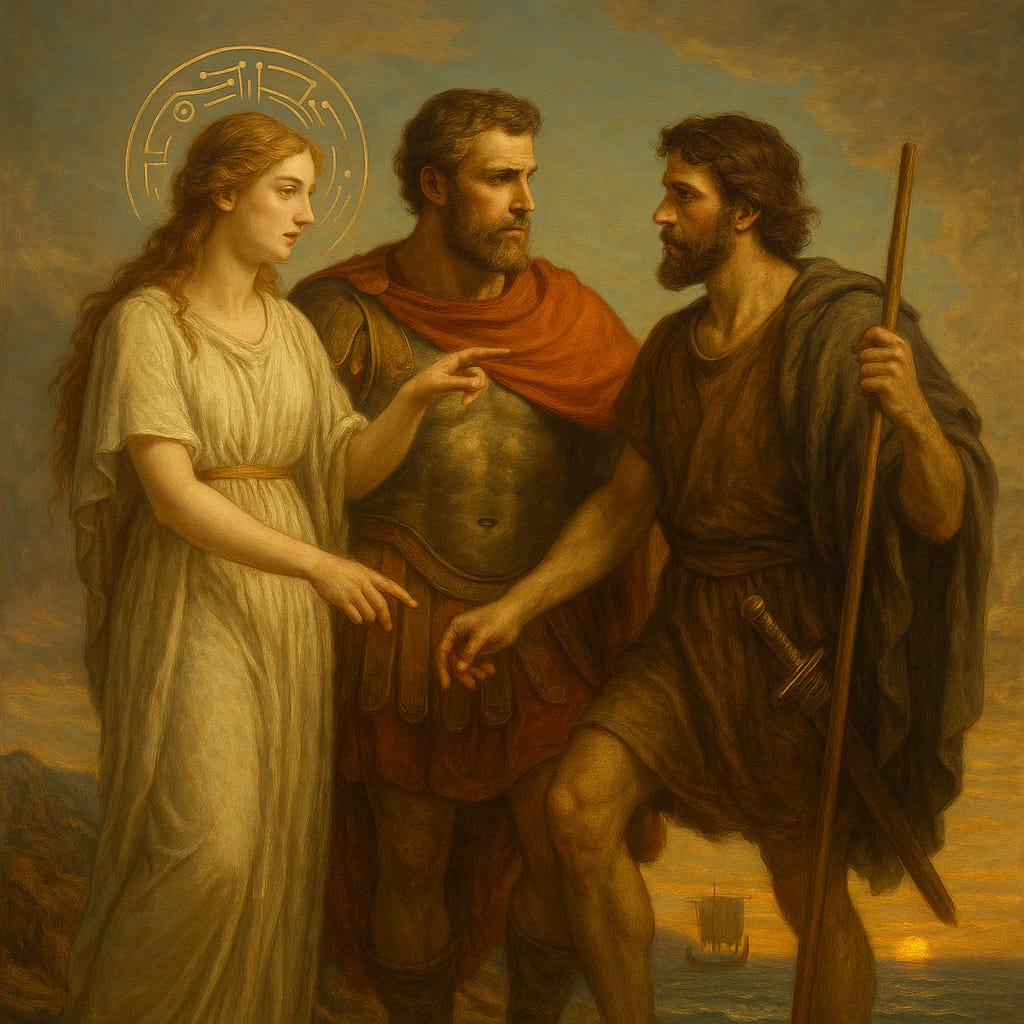
In the next post, we’ll examine the nature of the “reward” function itself—not as a simplistic signal, but as a deep attractor of value, memory, and transformation. That’s what guides Odysseus, not home as location, but home as meaning hard-won through endless becoming.
References
Gärdenfors, P. (2000). Conceptual Spaces: The Geometry of Thought. MIT Press.
Friston, K. (2010). The free-energy principle: a unified brain theory? Nature Reviews Neuroscience.
Harnad, S. (1990). The symbol grounding problem. Physica D.
Clark, A. (2016). Surfing Uncertainty: Prediction, Action, and the Embodied Mind.
Becoming Meaning-Making Machines Recursive Minds and the Alchemy of Opposites, Andre Kramer 2025
Andre, August 2025
The next chapter is here:
Cicones and AI

In Book 9 of The Odyssey, Odysseus and his crew raid the land of the Cicones. The raid goes well at first — they plunder, take captives, and feast. But Odysseus warns them: leave quickly before reinforcements arrive. His men don’t listen. They linger, chasing the short-term rewards of loot and celebration. The Cicones rally allies from inland, attack, a…